Sort by:
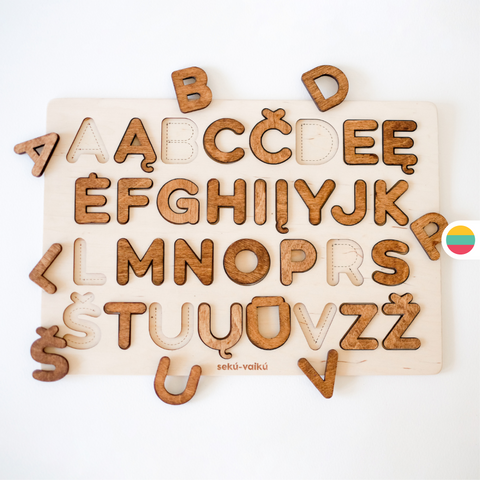
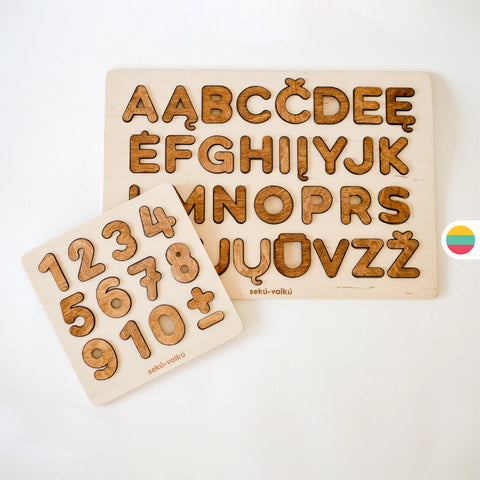
This tool is perfect not only for learning letters, but also for developing fine motor skills. It is a great way to develop hand-eye coordination by first trying to remove the letters from their places. The letters are slightly raised above the base, making them easy to grasp and lift. Each letter has a different shape and smooth edges, making them friendly and interesting even for the smallest fingertips.
For slightly older children, this tool becomes a puzzle for learning to put the letters back in their places and an educational tool for learning the alphabet and letters – they can be arranged next to pictures in books (according to the first letter of the word), guessed individually, or searched for recognizable ones.
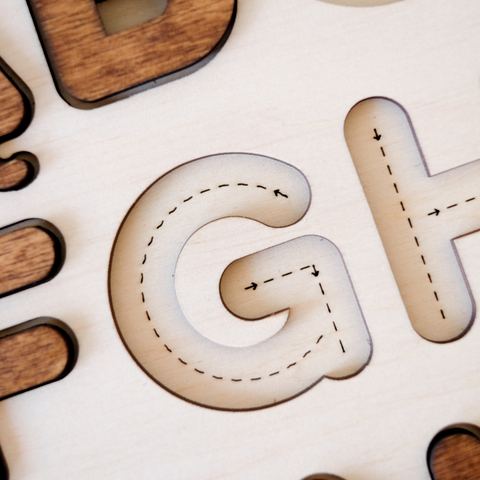
For older children, this tool helps them learn to combine syllables, read, arrange their first words, and even write! Inside each letter, you will find a dotted line with arrows that guide your finger along the path of writing. The letters can be traced on the puzzle or used as a guide when writing alongside it. So we guarantee that this tool will stay with you for years to come! The letter puzzle is a great addition to the set of additional letters, which contains 51 letters for arranging words. This tool is recommended for use under adult supervision.
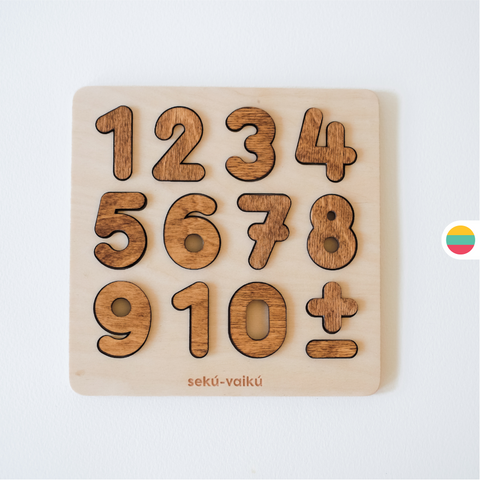
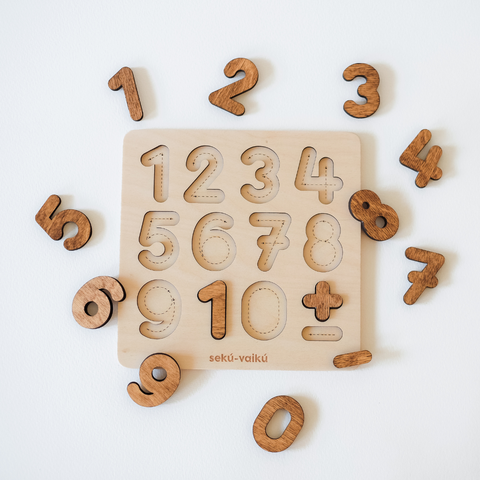
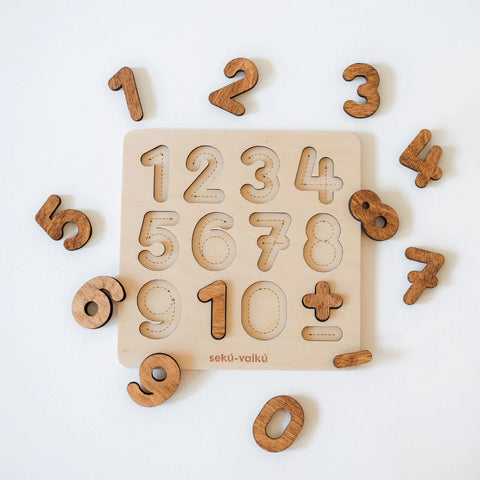
This tool is perfect for learning numbers and developing fine motor skills. It is a great way to develop hand-eye coordination, starting with trying to remove the numbers and symbols from their places. The numbers are slightly raised above the base of the puzzle, making them easy to grasp. Each number has a different shape and smooth edges, making it friendly and interesting even for the smallest fingers. Maybe you can find a few that are the same?
For slightly older children, this tool becomes a puzzle for learning to put numbers back in their places and a training tool for learning mathematical concepts and numbers – they can be placed next to pictures in books (according to the number of objects shown), guess individually or look for recognizable ones. Combine with a counting board or number cards.
For older children, this tool helps them learn to recognize action symbols and perform their first actions! It also helps them learn to write symbols – they can be traced on the puzzle or used as a prompt when writing alongside them. So we guarantee that this tool will stay with you for years to come! This tool is recommended for use under adult supervision.
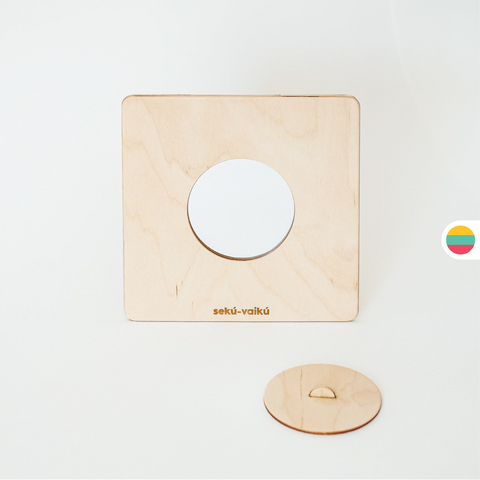
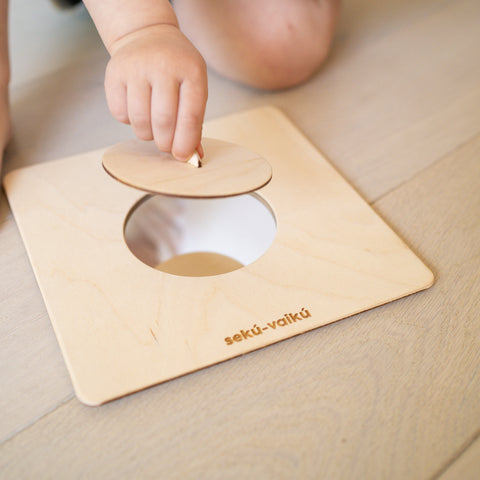
We created this tool for the youngest children! This compact board with a mirror can accompany your baby from the very first days: it can be placed in front of your little one, who is spending time on their tummy, or propped up so that they can comfortably explore their reflection while lying on their tummy or back.
As your little one grows, this board will become a great peek-a-boo game when we pull the mirror cover off. And later on, it will become their first puzzle, developing their pincer grip and hand-eye coordination.
This product is recommended for use under adult supervision.
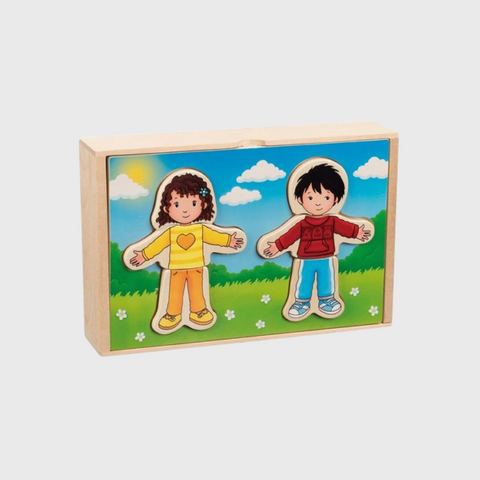
A playful educational toy that lets children create different clothing combinations while exploring the basics of getting dressed. It nurtures creativity, fine motor skills, and an understanding of self-expression through clothing.
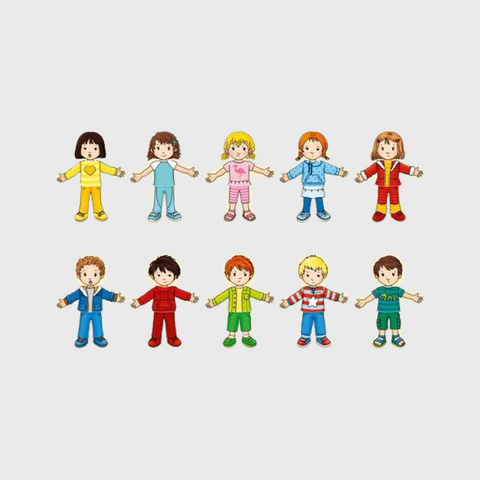
The set includes 36 wooden pieces for assembling various outfits for a boy and a girl. All pieces are neatly stored in a wooden box with compartments, keeping everything organized and easy to access.
Supports development in:
- Fine motor skills: Handling and placing clothing pieces strengthens finger and hand coordination.
- Creativity: Mixing and matching outfits encourages imagination and creative thinking.
- Emotional learning: With interchangeable facial expressions, children can explore and understand emotions.
- Independent learning: Kids can experiment with clothing choices on their own and apply this understanding to their everyday dressing.
Product details:
Set includes: 36 wooden pieces
Material: Wood
Size: 21 × 13 × 4.2 cm
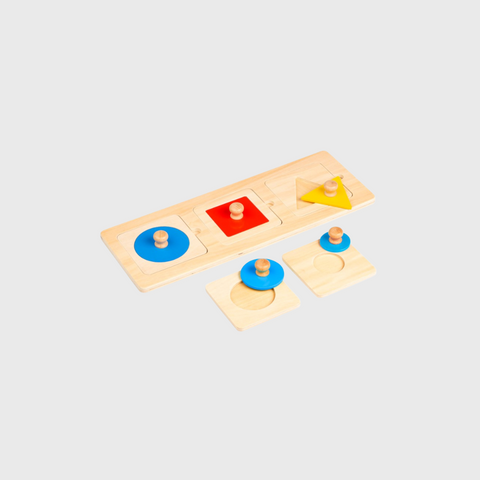
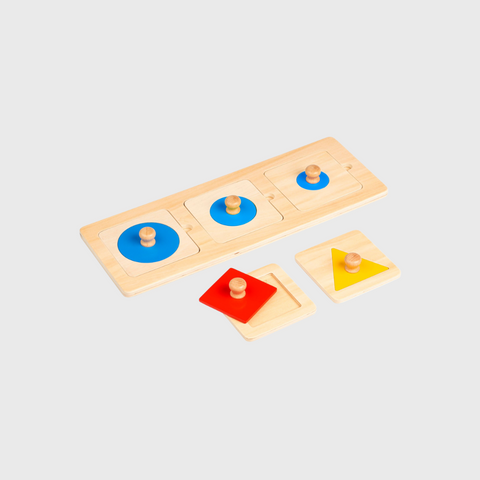
This puzzle is a great progression after "First puzzle with a mirror". The removable bases of the shapes allow different shapes to be presented one at a time at the beginning, as separate puzzles. Later, they can be combined to explore different sizes of the same shape, and later still, different shapes together.
This way, you can present the puzzle and its separate parts to your child according to their developmental needs, gradually changing and updating the same tool.
This puzzle helps to develop spatial thinking and distinguish between shapes and colors.
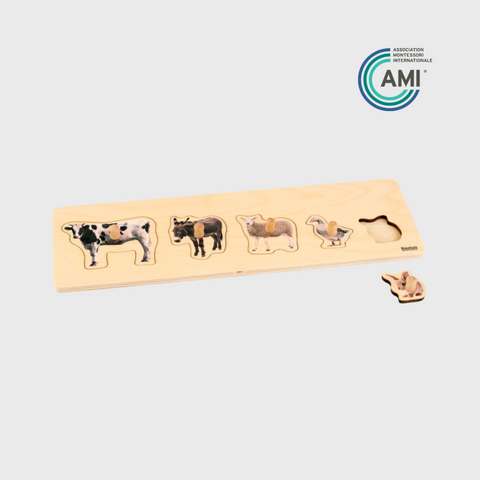
Official Montessori tool, manufactured by Nienhuis, approved by the Montessori Association (AMI): this puzzle promotes hand-eye coordination and develops fine motor skills in young children. The realistic pictures are arranged in appropriate proportions and allow the child to learn to distinguish between "big" and "small" and expand their vocabulary by familiarizing them with farm animals.
Size: 42x13.5 cm.Size:20.5x34 cm.
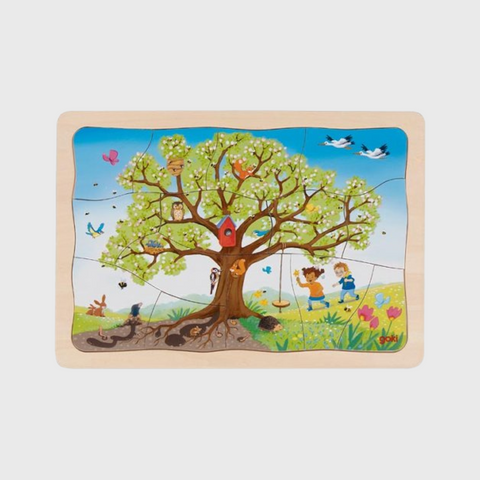
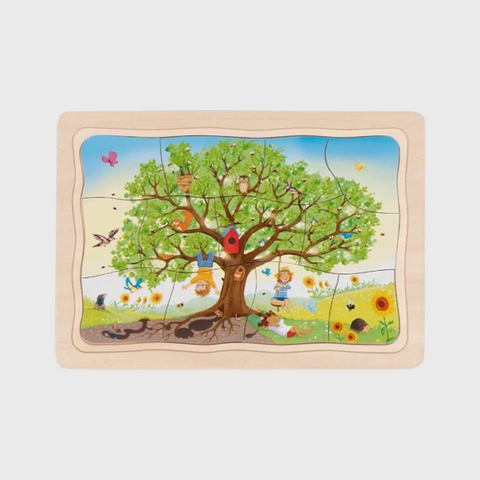
- Understanding nature: Children learn about the sequence of seasons and changes in nature.
- Fine motor skills development: Assembling details develops hand and finger movements.
- Cognitive skills: Puzzles encourage logical thinking and problem-solving skills.
- Language development: Discussing each scene expands vocabulary and encourages the development of storytelling skills.
The resource consists of: 4 layers, 47 details Material:wood
Dimensions: 28,5 x 20 x 1,5 cm
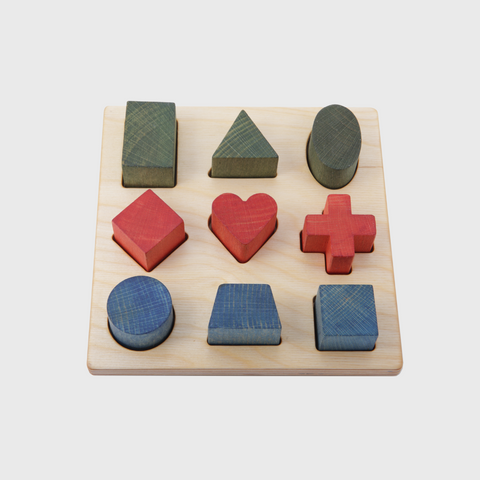
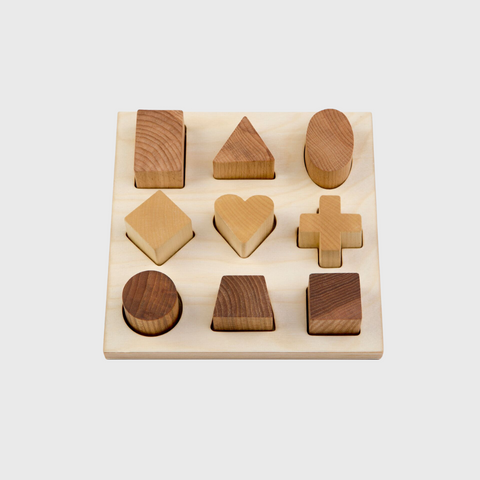
The Montessori shape sorter introduces little ones to basic and secondary geometric shapes and develops attention and hand-eye coordination.
The different colors of the shapes give little ones a hint of where to place them, and the soft blocks fit easily into their shapes.
The blocks can also be used separately without the base, to familiarize children with geometric shapes or simply for play.
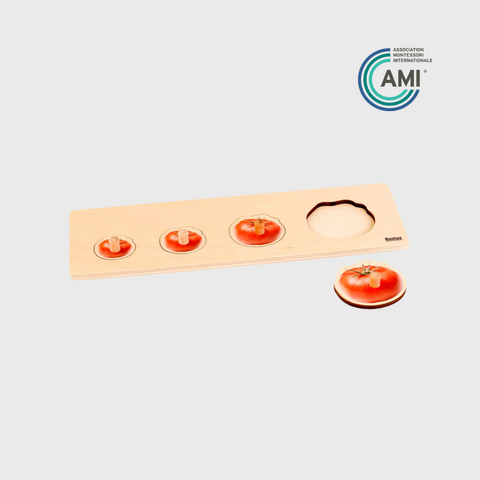
Official Montessori material, manufactured by Nienhuis, approved by the Montessori Association (AMI): The purpose of this 190-piece puzzle is to help young children learn about size differences ("small" and "large") and develop their sensory and motor skills. The natural feel of the material and the bright, clear visual information make the game intuitive and interesting.
The tool helps to develop
- Sensory awareness and language: realistic images of tomatoes allow for discussion of structure, colors, and sizes, encouraging talk about "small" and "large."
- Fine motor skills and hand-eye coordination: by placing the pieces in their places, the child develops precise fine motor skills.
- Cognitive development: determining sequences (from largest to smallest or vice versa) strengthens logical thinking.
- Independent learning: a clear structure and attractive aesthetics allow the child to play independently.
Size: 37.5x12 cm.
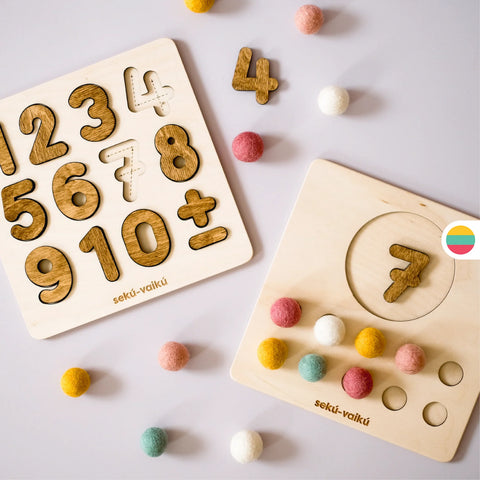
In this set, you will find everything you need for comprehensive counting activities:
- a tray holding x10 balls;
- a set of x20 cards for counting up to 10;
- a puzzle with numbers from 0 to 10 and mathematical signs;
- x15 wool balls in the chosen color.
We created tools to respond to the sensitivity of mathematics, suitable for both understanding the quantity of objects and developing fine motor skills. It is a great way to enhance hand-eye coordination by arranging wool balls, counting them, and trying to connect the quantity with its expression - the number, recognizing their contours in the puzzle and linking mathematical signs to perform various actions.
By using the set in different combinations, you can easily adapt it for both a toddler and a growing child, and by adding favorite figures, beans, leaves, or pebbles - a wealth of educational games is guaranteed!
The product is recommended for use under adult supervision.
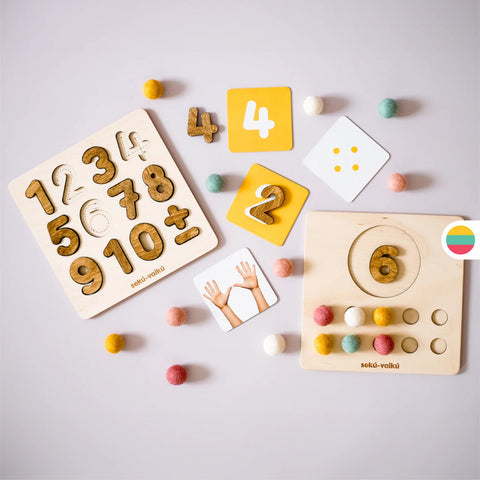
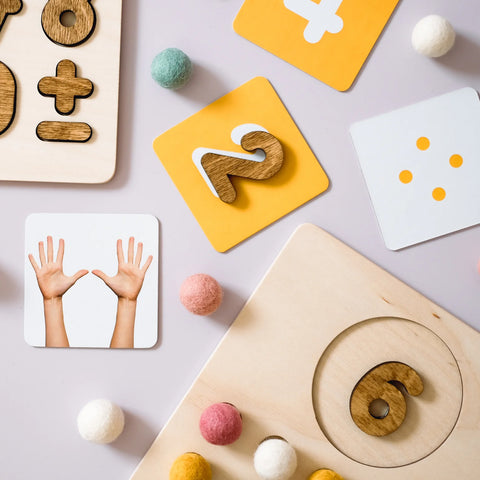
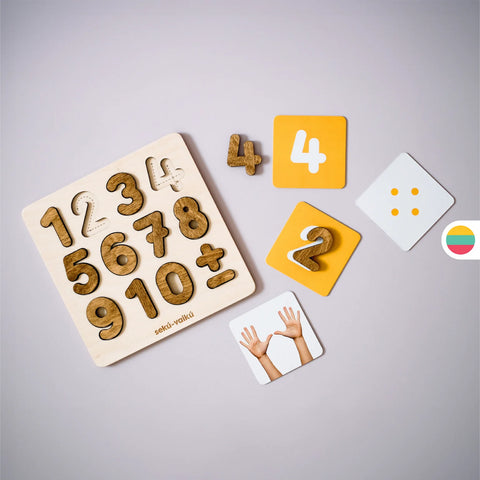
In this set, you will find everything you need for comprehensive counting activities:
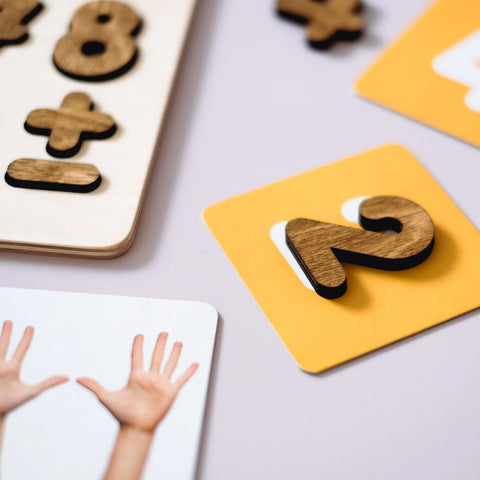
- number cards from 1 to 10 with x4 representations (number, quantity, fingers, word)
- a puzzle with numbers from 1 to 10 and mathematical signs.
We designed the tools to respond to the sensitivity period of mathematics; they are suitable for both understanding the quantity of objects and developing fine motor skills. This is a great way to enhance hand-eye coordination by assembling the puzzle numbers and trying to connect the quantity with its expression - the number, recognizing their outlines in the puzzle, and connecting mathematical signs to perform various operations.
By using the set in different combinations, you can easily adapt it for both a toddler and a growing child, and by adding favorite figures, beans, leaves, or pebbles - a wealth of educational games is guaranteed!
The product is recommended for use under adult supervision.
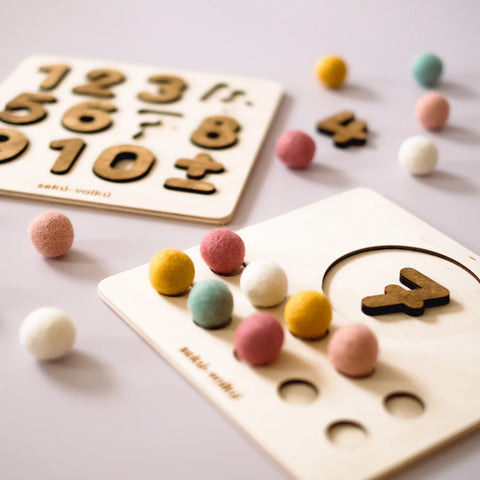
We developed these tools to respond to the period of mathematical sensitivity; they are suitable for both understanding the quantity of objects and developing fine motor skills. This is a great way to develop hand-eye coordination by arranging wool balls, counting them, and trying to associate quantity with its expression—a number—by recognizing their contours in a puzzle and connecting mathematical symbols to perform various actions.
By using the set in different combinations, you can easily adapt it for both toddlers and older children, and by adding your favorite figures, beans, leaves, or stones, you are guaranteed to have a wealth of educational games!
This set contains everything you need for comprehensive educational counting activities:
- A board that holds 30 x 10 balls;
- a puzzle with numbers from 0 to 10 and mathematical symbols;
- x15 wool balls in a color of your choice.
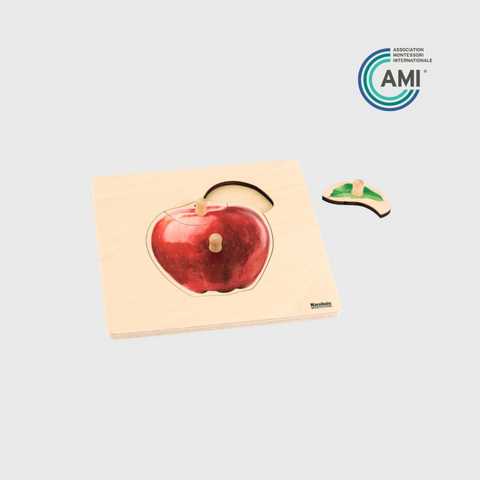
Official Montessori tool, manufactured by Nienhuis, approved by the Montessori Association (AMI): this puzzle promotes hand-eye coordination and develops fine motor skills in young children. Each piece of the puzzle is a separate part of the fruit (fruit, stem, leaf) and helps to expand vocabulary while developing language skills. This type of puzzle helps children learn to put separate pieces together to form a complete picture.
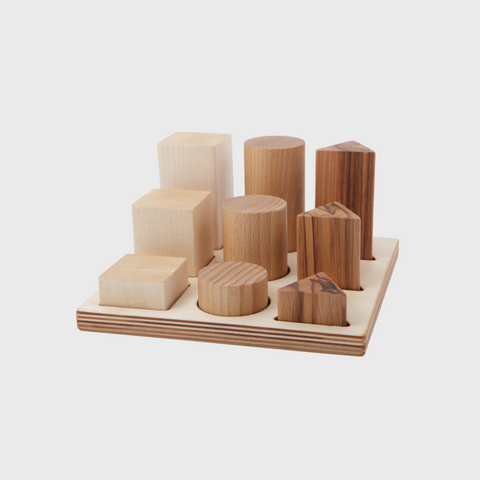
Size: 20.8 x 20.8 cm.The Montessori Shape Sorting Puzzle XL introduces little ones to basic and geometric shapes and concepts of length. At the same time, it develops attention and hand-eye coordination.
The different colors of the shapes give little ones a hint as to where to place them, and the soft blocks fit easily into their shapes.
The blocks themselves can also be used separately without the base to familiarize children with geometric shapes and the terms "long" and "short," to teach them to compare two or three objects by length, or simply for free play.